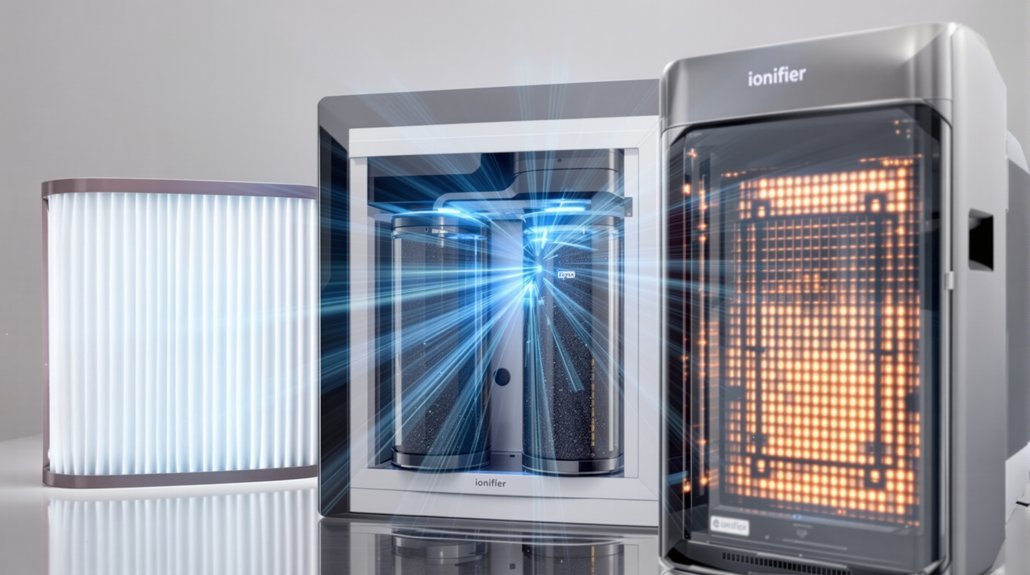

If you’re shopping for an air purifier, you’ve probably noticed three main technologies competing for your attention: HEPA filters, activated carbon, and ionizers. Each tackles indoor air pollution differently, and honestly, some work far better than others. Understanding what’s actually happening inside these machines—and why one popular type might be doing more harm than good—will help you make a smarter choice for your home.
Key Takeaways
- HEPA filters mechanically trap 99.97% of particles 0.3 microns and larger using dense fiberglass fibers that capture via impaction, interception, and diffusion.
- Activated carbon adsorbs gases, VOCs, and odors onto its porous surface but does not effectively remove airborne particles.
- Ionizers electrically charge particles so they clump together or settle on surfaces, but many produce harmful ozone as a byproduct.
- Combining HEPA with activated carbon provides complementary protection against both particles and gaseous pollutants for comprehensive air cleaning.
- Ionizers can generate ozone above safe levels, causing respiratory irritation; choose CARB-certified devices producing less than 0.05 ppm ozone.
How HEPA Filters Trap Particles Through Mechanical Filtration
HEPA filters trap airborne particles using a surprisingly simple approach: forcing air through a dense mat of randomly arranged fiberglass fibers. This mechanical filtration catches at least 99.97% of particles 0.3 microns and larger without chemicals or electricity.
Different-sized particles get captured in different ways. Larger particles (0.3–10 microns) slam into fibers through impaction or brush against them via interception. Smaller particles below 0.1 micron actually become easier to catch—diffusion causes them to zigzag randomly until they collide with fibers.
You’ll want a pre-filter to grab hair and lint before they clog your HEPA media. A pleated filter design increases surface area, reducing airflow resistance while maintaining efficiency. Replace your HEPA filter every 6–12 months, since accumulated debris eventually restricts airflow and diminishes performance.
Activated Carbon Technology and Gas Adsorption Explained
While mechanical filters excel at trapping particles, they can’t touch the gases, odors, and volatile organic compounds floating through your home.
That’s where activated carbon comes in. This porous material offers an enormous surface area—often 500 to 1,500 square meters per gram—that captures VOCs through adsorption rather than filtration.
Activated carbon’s secret weapon: up to 1,500 square meters of surface area packed into every single gram.
Here’s what affects your carbon filter’s performance:
- Carbon bed mass: More carbon means greater adsorption capacity and longer lifespan
- Adsorption kinetics: Slower airflow increases contact time, improving gas removal
- Pore size match: Micropores trap small VOCs while mesopores handle larger organics
Impregnated carbon treated with chemicals like potassium permanganate targets specific pollutants such as formaldehyde.
However, filter saturation occurs over time—expect replacement every 3–12 months depending on pollutant load.
How Ionizers Charge and Relocate Airborne Pollutants
Ionizers take a completely different approach to cleaning your air—instead of filtering particles out, they charge them up. These devices use corona discharge or needle electrodes to emit negative ions into your space.
When these negative ions attach to airborne particles, the charged particles either agglomerate into larger clumps or get pulled toward collection plates in electrostatic precipitators.
Here’s the catch: many charged particles simply settle onto room surfaces like walls, furniture, and floors. Your air seems cleaner, but those pollutants can be re-aerosolized when you dust or walk around. Electrostatic precipitators require regular plate cleaning to stay effective.
You should also know that corona discharge ionizers can produce ozone as a byproduct. Even small amounts of ozone production can irritate your lungs, making this a genuine health consideration.
Comparing Particle Removal Efficiency Across Filter Types
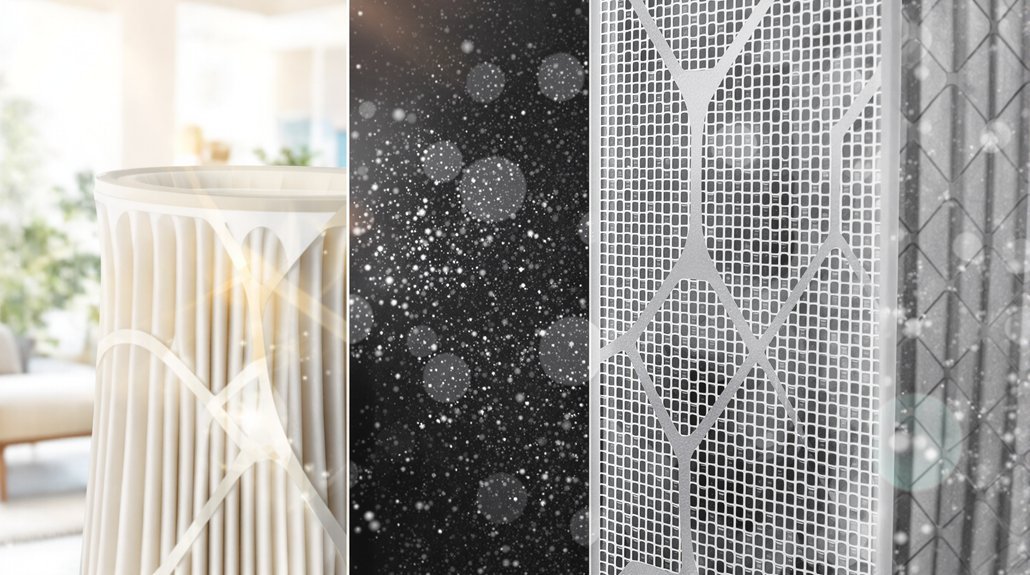
When you’re comparing filter types, the numbers tell a clearer story than marketing claims ever will. True HEPA filters capture 99.97% of airborne particles at 0.3 microns—that’s the standard you can trust. They’re also highly effective at removing PM2.5 and larger allergens like pollen and mold spores.
Here’s how each technology stacks up for particle removal:
- HEPA filters deliver consistent, measurable filter efficiency across particle sizes, with reliable CADR ratings you can compare.
- Activated carbon excels at gases and odors but won’t capture particles effectively on its own.
- Ionizers can target ultrafine particles down to 0.01 microns, but performance drops as collector plates get dirty—and some produce ozone as a byproduct.
For pure particle removal, HEPA remains the gold standard.
The Ozone Problem With Ionic Air Purifiers
Although ionic air purifiers can effectively target ultrafine particles, they come with a significant downside you shouldn’t ignore: ozone production. Ionizers use corona discharge to charge airborne particles, but this process generates ozone as a by-product. Even concentrations above 0.05 ppm can cause respiratory irritation, trigger asthma attacks, and worsen COPD symptoms.
California’s CARB standard caps ozone emissions at 0.050 ppm for air cleaners, and the American Lung Association advises against using ozone-producing devices entirely. Here’s another concern: ozone reacts with household VOCs to create secondary pollutants like formaldehyde and ultrafine particles.
Your safest choice? HEPA filters paired with activated carbon. These systems capture particles and absorb gases without generating any ozone, giving you cleaner air without the hidden health trade-offs.
When To Combine Multiple Filtration Technologies
Pairing a True HEPA filter with an activated carbon stage gives you the best of both worlds: the HEPA captures 99.97% of particles down to 0.3 microns (think pollen, dust mites, mold spores, and PM2.5), while the carbon adsorbs gases, odors, and VOCs like cigarette smoke or cooking fumes.
Here’s how to build an effective multi-stage system:
- Add a pre-filter to catch hair and pet fur, extending your HEPA filtration lifespan from six months to potentially twelve or more.
- Skip ionizers unless they’re CARB-certified for ozone emissions below 0.05 ppm—ionization can create more problems than it solves.
- Consider UV-C to inactivate microbes, but remember it won’t remove volatile organic compounds (VOCs) or particles.
Consistent filter maintenance keeps every stage working properly.
Choosing The Right Air Purifier For Your Health Needs
How do you pick the right air purifier when there are so many options on the shelf? Start by identifying your main concern. For allergens like pollen, pet dander, or dust mites, a True HEPA filter captures 99.97% of particles down to 0.3 microns—including PM2.5. If you’re battling smoke, cooking odors, or volatile organic compounds (VOCs), you’ll want activated carbon filters paired with HEPA.
| Your Concern | Best Filter Choice |
|---|---|
| Allergens, dust, PM2.5 | True HEPA |
| Odors, VOCs, smoke | HEPA + Activated Carbon |
| Chemical fumes | HEPA + Activated Carbon |
| General air quality | True HEPA (CADR-matched) |
Avoid standalone ionizers—they produce ozone, which irritates lungs. Always match your purifier’s CADR to your room size for effective, continuous cleaning.
Frequently Asked Questions
Which Is Better HEPA or Ionizer Air Purifier?
You’ll get better results with a True HEPA air purifier. It captures 99.97% of allergens at 0.3 microns, while ionizers just move particles onto surfaces where they’re stirred up again.
HEPA models do have higher maintenance cost from filter replacement every 6–12 months, but they’re safer—ionizers can produce lung-irritating ozone. For odor control, add an activated carbon stage. Check noise levels and room size ratings before buying.
Do Ionizers Work Better Than Air Purifiers?
No, ionizers generally don’t outperform HEPA air purifiers.
While needlepoint ionization and corona discharge enable charged particle removal through electrostatic deposition and ion clustering, particles often settle on surfaces, creating surface re-entrainment risks.
Ozone production can irritate your lungs.
HEPA filters capture 99.97% of particles at 0.3 µm without airflow disruption or harmful byproducts.
You’ll also appreciate HEPA’s maintenance simplicity and lower noise generation compared to electrostatic units.
Why Can’t You Be in a Room With an Ionizer?
You can stay in a room with an ionizer, but it’s not ideal.
Ozone production—even at levels below regulatory limits—causes respiratory irritation and affects indoor air chemistry over time.
Long term exposure worsens symptoms for vulnerable populations like asthmatics.
Ionizers also cause allergen redistribution, pushing particles onto surfaces rather than removing them.
Secondary particle formation and altered odor perception are additional concerns.
Electronic interference is minimal but possible with sensitive devices.
Which Is Better HEPA or Activated Carbon Air Purifier?
Neither one’s universally better—it depends on your needs. HEPA efficiency excels at particle capture, trapping 99.97% of allergens like pollen and pet dander.
Activated carbon handles odors and gases HEPA can’t touch. For allergen removal, go HEPA. For smoke or VOCs, you’ll want carbon. Many units combine both.
Consider filter lifespan, replacement filters cost, room coverage, noise levels, energy consumption, and maintenance needs when comparing options.
Bottom Line
When you’re shopping for an air purifier, your best bet is a combo unit with True HEPA and activated carbon. You’ll capture 99.97% of particles down to 0.3 microns while also tackling odors and gases. Skip standalone ionizers—they can produce ozone and require constant plate cleaning. Match your purifier’s capacity to your room size, replace filters on schedule, and you’ll breathe noticeably cleaner air.