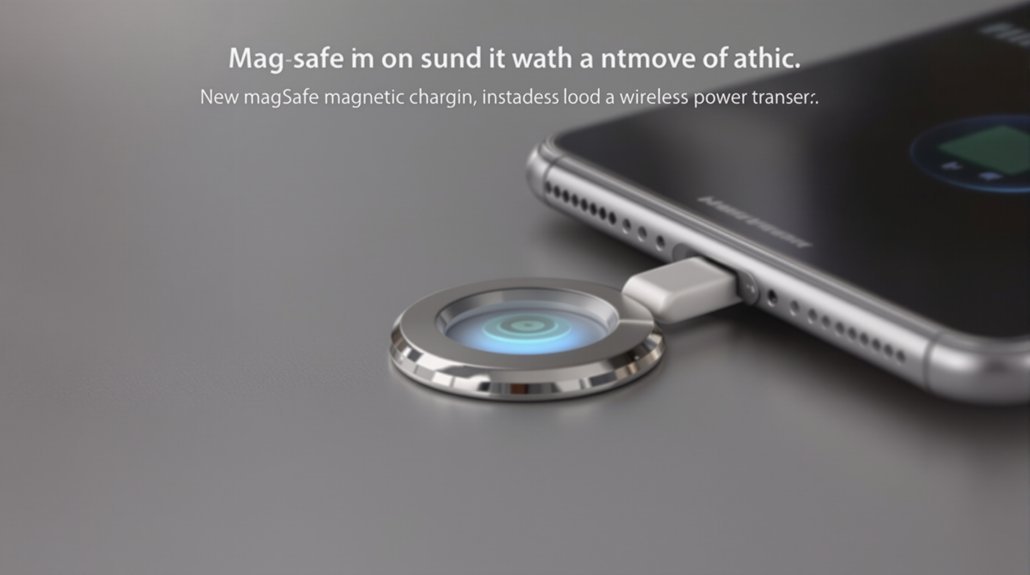

You’ve probably snapped a MagSafe charger onto your iPhone and watched the battery icon light up, but what’s actually happening beneath that glass back is surprisingly clever. A ring of powerful magnets does more than just hold things in place—it’s the key to faster, more efficient wireless charging. The real magic involves electromagnetic fields, precise alignment, and some smart power management that keeps your phone from overheating.
Key Takeaways
- Neodymium magnets in the iPhone snap the charger into perfect alignment over the internal wireless charging coil.
- Alternating current in the MagSafe puck creates a changing magnetic field that induces current in the iPhone’s receiving coil.
- The induced AC current is converted to DC by a rectifier, then regulated by a power management chip for safe battery charging.
- Magnetic centering maximizes electromagnetic coupling between coils, enabling efficient power transfer up to 25W on newer models.
- Temperature sensors monitor heat during charging, triggering throttling to protect battery health and prevent damage.
The Magnetic Array Behind the Snap
At the heart of MagSafe’s satisfying snap lies a precisely engineered ring of magnets—typically neodymium—built directly into your iPhone’s rear housing. This MagSafe magnetic array creates both strong axial pull and self-centering torque, so your charger automatically aligns with the internal Qi coil every time.
Here’s why magnetic alignment matters: traditional wireless charging suffers from lateral misalignment losses. When coils don’t line up, charging power transfer drops markedly. The neodymium magnets solve this by centering accessories concentrically over your phone’s coil, boosting wireless charging efficiency and enabling power levels up to 25W on newer models.
Made for MagSafe accessories often include accessory identification circuitry within the magnetic ring. This lets your iPhone recognize what’s attached and adjust charging behavior accordingly—smart engineering that you’ll never see but always benefit from.
How Power Transfers Through the Charging Coil
Because MagSafe relies on electromagnetic induction, your charger doesn’t actually touch any electrical contacts on your iPhone—instead, it transfers energy through thin air.
MagSafe transfers power through thin air—no electrical contacts needed, just electromagnetic induction at work.
Here’s how it works: an alternating current flows through the charging coil in your MagSafe puck, creating a changing magnetic field. This field passes through the magnetic ring and induces a matching current in your iPhone’s receiving coil.
This process, called inductive coupling, follows the same principles as Qi wireless charging. The key difference? MagSafe’s magnets guarantee perfect coil alignment every time, which dramatically improves efficiency.
Once that induced current reaches your iPhone, a rectifier converts it from AC to DC.
Then a power management IC regulates the flow, communicating with your battery to deliver safe, optimized power transfer to your device.
Why Alignment Matters for Efficient Charging
While inductive charging works even with imperfect placement, precise alignment makes a dramatic difference in how quickly and efficiently your iPhone charges. MagSafe’s magnetic centering positions the charger’s coil directly over your iPhone’s charging coil, creating ideal electromagnetic coupling. This precision enables peak power delivery up to 15W on standard MagSafe or 25W on newer implementations.
Without proper alignment, wireless power transfer suffers markedly. Standard Qi charging with manual placement often drops to 7.5W or lower when coils don’t overlap correctly. Misalignment increases the distance between coils and creates uneven energy transfer, which reduces efficiency and generates excess heat. Your iPhone’s software responds by throttling charging above 80% to protect battery health. MagSafe’s magnetic centering eliminates these problems automatically, minimizing energy loss every time you charge.
MagSafe vs. Standard Qi Wireless Charging
MagSafe and standard Qi charging both rely on the same inductive technology, but they differ markedly in how they handle alignment and power delivery.
With magnetic alignment, MagSafe snaps your iPhone’s charging coil into perfect position every time. Standard Qi wireless charging depends on you placing your phone just right—and even small misalignment cuts alignment efficiency and generates extra heat.
That precision matters for speed. MagSafe delivers 15W fast charging on supported iPhones, while most Qi chargers top out at 7.5W. Newer MagSafe-compatible chargers push up to 25W on iPhone 16 and 17 Pro models.
Your phone also communicates with MagSafe to manage thermal throttling, protecting your battery. If you’re using a non-MagSafe device, you’ll need the Qi2 protocol to match those wireless charging speed benefits.
Power Adapters and Wattage Requirements by Iphone Model
Getting the fastest MagSafe speeds depends on pairing your iPhone with the right power adapter. For iPhone 17 Pro, iPhone 17, and iPhone 16 Plus/Pro Max, you’ll want a USB-C power adapter rated at 30W or higher that delivers 15V/2.0A. These models can hit up to 25W peak fast wireless charging with the proper setup.
iPhone 16 and 16 Pro max out at 22.5W, while iPhone 15 and earlier models typically cap at 15W with a 20W adapter. Here’s a tip worth remembering: if you place your phone on the charger before plugging in the adapter, adapter negotiation may lock in a lower wattage.
Simply remove your iPhone for three seconds after connecting power, then set it back down for maximum charging speed.
Heat Management and Battery Protection During Charging
Because wireless charging generates more heat than a cable connection, your iPhone relies on built-in temperature sensors to protect the battery during MagSafe sessions. These safety sensors continuously monitor charging temperature and trigger thermal throttling when things get too warm. You’ll notice wireless power delivery slows down automatically above 80% charge or when internal temps rise.
Your iPhone and MagSafe charger handle power negotiation together, verifying the safe maximum wattage before ramping up speed. Using the recommended charging adapter wattage—30W or higher for iPhone 16 and 17 models—improves charging efficiency and reduces unnecessary heat buildup.
For best battery protection, avoid placing metal objects or non-certified cases between your phone and charger. Trapped metal creates hotspots that can damage both devices.
Frequently Asked Questions
Do Magsafe Chargers Actually Work?
Yes, MagSafe chargers genuinely work well. The magnet alignment guarantees precise device positioning, boosting charging efficiency compared to standard wireless vs. misaligned Qi pads. You’ll get charging speeds up to 15–25W with the right adapter.
Case compatibility matters—thick cases or magnetic interference from metal objects can reduce performance. Thermal throttling may slow charging when your phone gets warm. The accessory ecosystem uses charge authentication, so stick with certified products for best results.
How Does Magsafe Charging Work?
MagSafe uses magnetic coupling to snap your charger into perfect coil alignment with your iPhone’s internal charging coil.
Once connected, inductive resonance transfers energy wirelessly while power negotiation between devices determines safe wattage—up to 25W on newer models.
The charging protocol includes foreign object detection and thermal management to prevent overheating.
Case interference can reduce efficiency losses, so you’ll want MagSafe-compatible cases.
Data pins aren’t involved—it’s purely wireless.
What Are the Downsides of Magsafe Charging?
You’ll notice heat buildup during wireless charging, which can accelerate battery wear over time.
Charging speed maxes out at 15–25W versus faster wired options, and power loss occurs during energy transfer.
Accessory cost runs higher than standard cables, and case compatibility varies—thick cases hurt pad alignment.
You shouldn’t place credit cards nearby due to magnetic interference.
Connector stress isn’t an issue, but safety concerns are minimal with certified chargers.
Why Was Magsafe Discontinued?
Apple’s decision to discontinue the original MagSafe came down to connector redundancy when USB-C emerged.
You saw the wireless evolution and design priorities shift toward one universal port. Manufacturing costs dropped with standardized parts, and market demand favored versatility over dedicated charging ports.
User feedback supported thinner laptops with fewer jacks.
While durability concerns and licensing disputes played minor roles, the growing accessory ecosystem around USB-C made the switch practical.
Bottom Line
You’ve now seen how MagSafe combines precise magnet alignment with inductive charging to deliver up to 15 watts efficiently. The system’s smart temperature monitoring and power negotiation protect your battery while maximizing speed. Whether you’re upgrading from standard Qi or buying your first wireless charger, MagSafe’s snap-and-charge simplicity makes topping off your iPhone effortless. Just pair it with the right adapter, and you’re set.