
Picking an air purifier sounds simple until you realize the wrong size wastes energy, makes too much noise, or barely cleans the air you’re breathing. The key number you’ll need is called CADR—Clean Air Delivery Rate—and matching it to your room’s square footage determines whether you’ll actually notice a difference. Before you spend a dollar, there’s one quick calculation that changes everything.
Key Takeaways
- Calculate your room’s square footage by multiplying length times width, then multiply by two-thirds to find minimum CADR.
- Look for AHAM-verified CADR ratings on packaging, which provide independent third-party testing rather than manufacturer claims.
- Adjust CADR requirements upward for ceilings higher than 8 feet using room volume calculations for proper air changes.
- Match purifier capacity to room activity: bedrooms need 4-5 ACH while basements or high-pollution areas require 5-6+ ACH.
- Avoid undersized units that run constantly at maximum speed, causing excessive noise, filter wear, and higher electricity costs.
Understanding Clean Air Delivery Rate (CADR) and Why It Matters
When you’re shopping for an air purifier, CADR is the single most important number to understand.
Clean Air Delivery Rate measures how quickly a purifier removes airborne particles—specifically smoke, pollen, and dust—in cubic feet per minute. Think of it as the speed at which clean air flows into your space.
CADR tells you exactly how fast an air purifier can deliver particle-free air to your room.
Look for AHAM-verified models. These CADR ratings come from independent third-party testing, recognized by both the EPA and American Lung Association. You’ll find them printed right on the packaging.
Here’s a simple rule for matching CADR to room size: your CADR rating should be at least two-thirds of your square footage.
A 200 square foot bedroom? You’ll want roughly 133 CFM. This calculation assumes standard 8-foot ceilings and helps guarantee adequate Air Changes per Hour for effective particle removal.
Measuring Your Room to Determine Square Footage and Volume
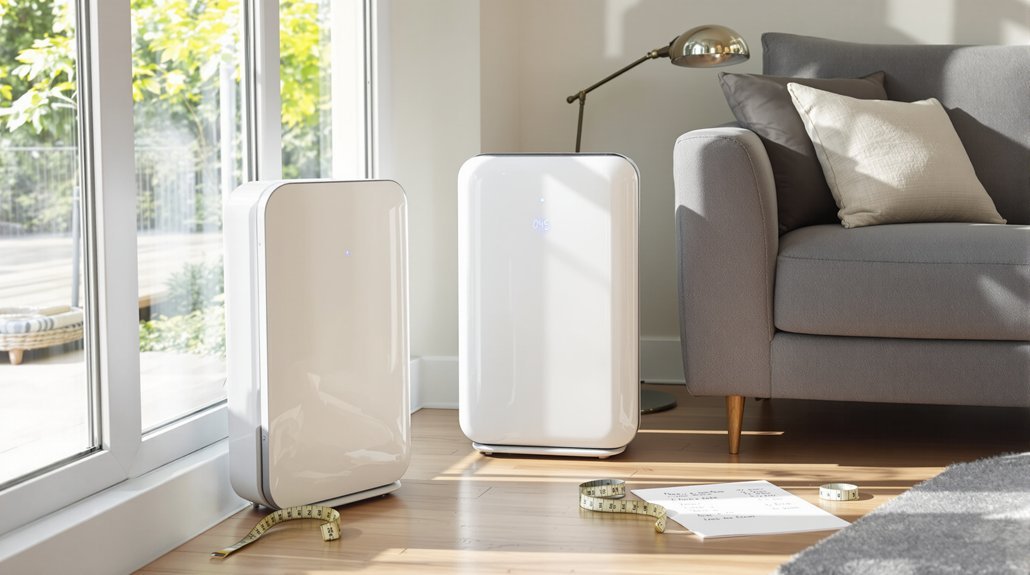
Before you can match an air purifier to your space, you’ll need to grab a tape measure and calculate your room’s actual dimensions.
Start by measuring the room’s floor area. Simply multiply length × width in feet—a 12 ft × 15 ft bedroom gives you 180 square footage. For irregular spaces, divide into rectangles, measure each section, then add them together.
Don’t forget ceiling height matters too. Calculate room volume by multiplying length × width × height. That same bedroom with 8-foot ceilings equals 1,440 cubic feet.
Here’s what you’ll need to record:
- Room length in feet
- Room width in feet
- Ceiling height in feet
- Total square footage of connected spaces you want purified
These measurements help you determine proper ACH and CADR requirements for effective air cleaning.
Calculating the Minimum CADR Needed for Your Space
Although you’ve measured your room’s square footage, you still need one key number to find the right air purifier: the Clean Air Delivery Rate, or CADR. This metric tells you how quickly a unit cleans air. The AHAM guideline recommends a minimum CADR (CFM) of two-thirds your room square footage. For rooms with non-standard ceiling height, calculate room volume (length × width × height) and multiply by your desired ACH, then divide by 60.
| Room Square Footage | Minimum CADR Needed |
|---|---|
| 150 sq ft | 100 CFM |
| 200 sq ft | 133 CFM |
| 300 sq ft | 200 CFM |
| 400 sq ft | 267 CFM |
Don’t trust manufacturer claims alone. Always verify AHAM-certified Air Delivery Rate (CADR) ratings for accurate performance data.
Matching Air Purifier Size to Room Type and Activity Level
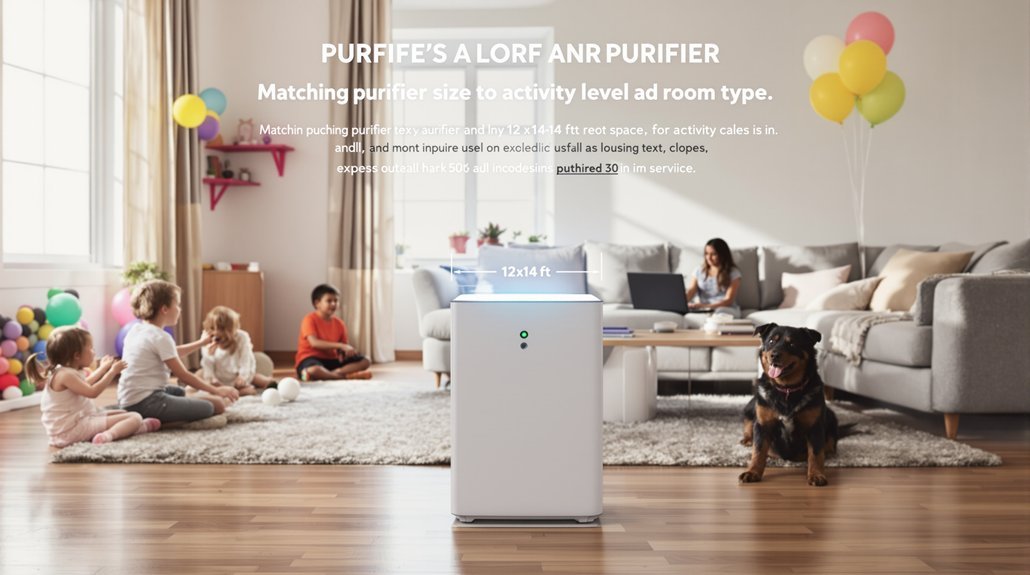
Knowing your minimum CADR gives you a solid starting point, but the best air purifier for your space also depends on what happens in that room.
Here’s how to match your purifier to different spaces:
- Bedrooms and nurseries: Target a CADR of at least 2/3 your room square footage to achieve 4–5 ACH for restful sleep.
- Living rooms and home offices: Choose a unit with CADR about 1.5× your square footage to handle dust, pet dander, and light cooking.
- Basements or high-pollution areas: Aim for 5–6+ air changes per hour with a 300+ CFM unit or multiple purifiers.
- Small rooms: A compact purifier delivering 4+ ACH keeps noise low while staying effective.
For odors or VOCs, add activated carbon filtration to your checklist.
Avoiding Common Sizing Mistakes That Waste Energy and Reduce Performance
Even after you’ve calculated your room’s square footage and identified a target CADR, it’s easy to make sizing errors that cost you money and clean air.
An undersized unit runs constantly at maximum fan speeds, burning through filters and electricity while never achieving adequate ACH. Oversized units create the opposite problem—they’re loud, power-hungry, and wasteful in small spaces.
Getting the size wrong costs you either in constant noise and energy bills or in air that never gets clean.
Don’t forget cubic volume matters too. A room with 12-foot ceilings needs substantially more CADR than one with standard 8-foot ceilings, even if the floor space matches.
When a single purifier can’t deliver your target air changes per hour, multiple units work better than one struggling machine. Place them strategically to eliminate stagnant corners.
This approach often proves more efficient and quieter than forcing one device to do everything.
Frequently Asked Questions
How Do You Determine What Size Air Purifier You Need?
Start by calculating your room volume—multiply length, width, and ceiling height.
Then check CADR ratings to make certain the purifier delivers enough airflow cycles per hour, typically 4–6 for homes.
You’ll also want to factor in furniture placement, window leaks, and door gaps since these affect air circulation.
Consider occupancy levels and pollutant type too; more people or specific allergens may require higher capacity.
Match these variables for effective purification.
Can an Air Purifier Be Too Big for a Room?
Yes, an air purifier can be too big. An oversized unit creates excessive noise, unnecessary energy use, and potential cost inefficiency over time.
You might experience uneven circulation or uncomfortable drafts in smaller spaces. While filter overcapacity won’t harm air quality, it does add maintenance burden since you’re replacing filters designed for larger volumes.
Choose a CADR that modestly exceeds your room’s needs, or pick a variable-speed model you can dial down.
How to Decide Which Air Purifier to Get?
Start by matching CADR to your room size, then factor in budget considerations and brand reputation.
Check noise levels if you’re placing it in a bedroom.
Consider filter lifespan and maintenance effort—some filters need replacing every 6–12 months.
Look for energy efficiency ratings and smart features like auto-mode or air quality sensors.
Finally, think about your specific allergen types and follow placement tips for best airflow.
Which Is Better, PM 0.1 or 2.5 Filter?
PM0.1 filters offer better particle capture and filter efficiency, especially for viral removal and ultrafine smoke. They handle particles 25 times smaller than PM2.5 filters, which matters for health impact in areas with combustion or infectious aerosols.
However, PM0.1 filters have shorter filter lifespan and higher cost effectiveness concerns due to increased pressure drop.
For real world performance, check measurement standards and sensor accuracy—PM2.5 filters work fine for basic dust and pollen control.
Bottom Line
You’ve now got the tools to match any air purifier to your space. Measure your room, calculate the minimum CADR using the two-thirds rule, and verify the rating through AHAM. Don’t forget to account for ceiling height and room activities. A properly sized unit runs efficiently, lasts longer, and actually cleans your air. Take these numbers with you when you shop—your lungs will thank you.