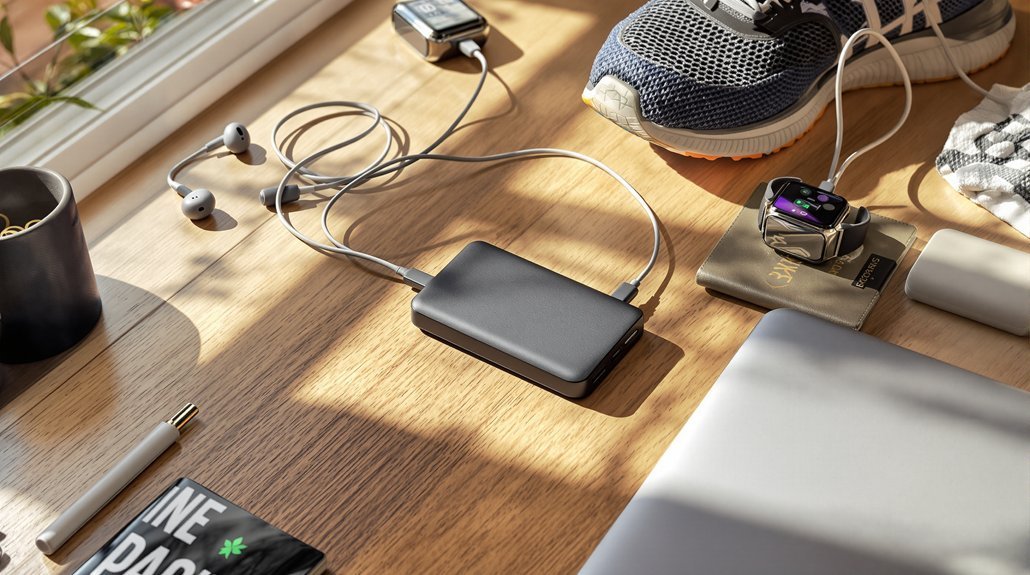

You’ve probably stood in a store or scrolled through dozens of listings, wondering why power banks range from $15 to $150—and whether the expensive one is actually worth it. The truth is, the right choice depends entirely on how you live: your commute, your devices, and how often you’re away from an outlet. Get it wrong, and you’re stuck with dead weight or a dead phone.
Key Takeaways
- Match capacity to your daily usage: 5,000–10,000 mAh for light users, 20,000 mAh for heavy travelers or laptop charging.
- Choose output wattage based on your devices: 18–30W for smartphones, 45–100W for laptops requiring USB-C Power Delivery.
- Prioritize portability by selecting pocket-friendly units under 250g for daily carry or larger packs for extended trips.
- Verify essential safety features including overcharge protection, short-circuit prevention, and thermal cutoff before purchasing.
- Check airline compliance by confirming the watt-hour rating stays under 100 Wh for hassle-free travel.
Understanding Power Bank Basics and Key Terminology
Every power bank spec sheet throws around terms like mAh, Wh, and watts—understanding what they mean helps you avoid overpaying or buying underpowered gear.
Power bank capacity (mAh) tells you how much energy the battery holds. A 10,000 mAh unit delivers roughly 1.8 full charges to a 5,000 mAh phone due to battery efficiency (conversion loss) of about 80%.
Watt-hours (Wh) matter for airline limits (carry-on Wh)—most carriers allow up to 100 Wh without special approval.
Output power (W/amps) determines charging speed. You’ll want fast charging (18W+) for phones, 30W+ for tablets, and 45–100W for laptops.
Check that ports (USB-A/USB-C) support USB-C Power Delivery (PD) for maximum compatibility.
Don’t overlook safety protections (overcharge/short-circuit) and pass-through charging if you need simultaneous device charging.
Determining the Right Capacity for Your Daily Needs
Because your power bank’s stated capacity doesn’t equal what actually reaches your device, you’ll want to think with respect to usable charges rather than raw numbers. When evaluating battery capacity in milliamp hours (mAh), factor in 70–85% efficiency. A 10,000 mAh portable battery actually delivers around 7,000–8,500 mAh of usable capacity.
For device compatibility, match your power bank to your phone’s battery. A 10,000 mAh unit typically provides about two full phone charges for most modern smartphones. That’s the sweet spot for everyday carry.
Need more juice? A 20,000 mAh option offers roughly three to 3.5 charges and can even power some laptops. Check the watt-hour (Wh) rating too—most 20,000 mAh packs run around 72–74 Wh, keeping you airline-compliant for travel.
Matching Output Power to Your Devices for Fast Charging
Capacity tells you how much energy your power bank holds, but output power determines how quickly that energy flows into your devices. You’ll want to match output wattage to your device’s needs—smartphones typically need 18W for fast charging, while laptops often require 45W to 100W.
| Device Type | Recommended Output |
|---|---|
| Smartphones | 18W–30W |
| Laptops | 45W–100W |
USB-C Power Delivery offers the fastest wired speeds, so look for PD ratings like 18W/30W/45W/65W/100W depending on your gear. Check the amps (A) too—3A at 9V delivers 27W of power. If you prefer wireless charging via Qi or MagSafe, expect around 15W maximum. When using multiple ports simultaneously, total output gets divided, which may slow individual device compatibility.
Balancing Size, Weight, and Portability
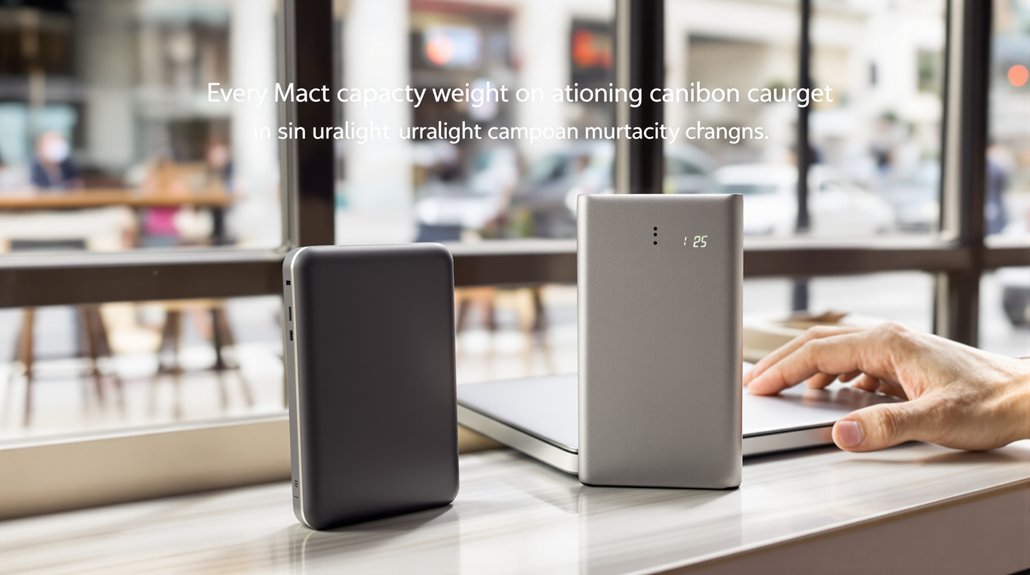
While raw capacity matters, the physical trade-offs of size and weight often determine which power bank you’ll actually carry with you.
Capacity means nothing if your power bank lives in a drawer—portability is what keeps you charged.
For everyday pocket carry, you’ll want a compact design in the 5,000–10,000 mAh range. These pocketable units typically weigh 150–250 grams and deliver one to two full phone charges. If you need more portable power, a 20,000 mAh bank provides three or more charges but weighs 300–400 grams—better suited for a bag than your jeans.
Check the power-to-weight ratio before buying. Good pocketable models offer 40–60 mAh per gram of weight (grams). Higher numbers mean better portability for your capacity (mAh).
Don’t overlook USB-C input for faster recharging. An integrated cable adds convenience but increases bulk. Choose features that match how you’ll actually carry the unit.
Essential Safety Features You Should Never Skip
Size and weight affect whether you’ll carry a power bank, but safety features determine whether you should carry it at all.
Look for overcharge protection and over-discharge protection—these prevent damage to both your devices and the power bank’s internal cells. Short-circuit protection and surge protection cut power instantly if something goes wrong, stopping potential fires before they start. Temperature regulation with thermal cutoff sensors will shut things down if heat reaches dangerous levels.
| Protection Type | What It Does | Why It Matters |
|---|---|---|
| Overcharge/Over-discharge | Stops charging at 100%, protects cells | Extends battery life, prevents swelling |
| Short-circuit/Surge | Cuts power during faults | Prevents fires and device damage |
| Thermal cutoff | Shuts down at unsafe temps | Stops overheating and thermal runaway |
Always verify safety certifications like UL, CE, or FCC. Check for intelligent current regulation and smart circuitry that auto-detects your device’s needs. Confirm max output specs match your gear.
Must-Have Extras: Ports, Cables, and Wireless Charging
Beyond safety features, the ports and charging options on your power bank determine how well it’ll actually fit into your daily life. Look for at least one USB-C PD output (18–30W) for fast-charging modern phones, plus a USB-A port for older devices. Input wattage matters too—a 45–60W USB-C input will fast recharge a 20,000 mAh capacity bank in roughly three hours instead of eight.
If you want cable-free convenience, Qi2/MagSafe wireless charging at 15W works great, though you’ll lose some efficiency compared to wired connections. Integrated cables offer grab-and-go simplicity, but consider ports and durability—having at least one standard port gives you a backup. Finally, check simultaneous output capability so multiple devices charge at useful speeds without throttling each other.
Power Banks for Commuters, Travelers, and Outdoor Adventurers
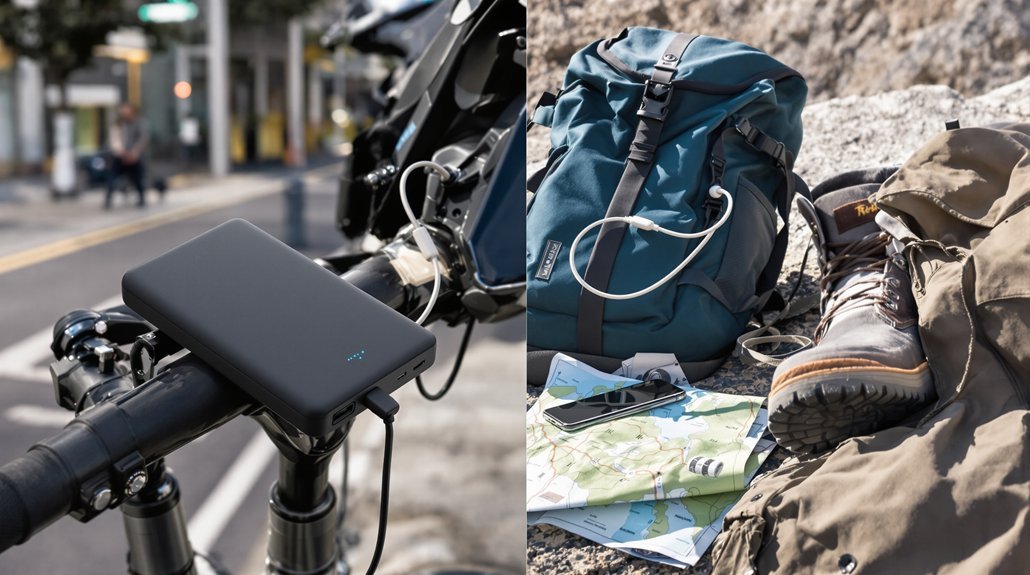
Now that you’ve got a handle on ports and charging options, let’s match the right power bank to your lifestyle.
Commuters benefit from a compact, portable power bank with 5,000–10,000 mAh capacity. Look for USB‑C PD fast charging at 18–27W, and keep weight vs capacity in mind—aim for under 300 grams.
Travelers need more juice. A 20,000 mAh unit with multiple ports handles phones and tablets easily. If you’re charging laptops, choose 45–100W USB‑C PD output. Always check airline watt‑hours limits and pack it in your carry-on.
Outdoor adventurers should prioritize rugged (IP67) construction with 15,000+ mAh. Solar compatibility and built-in flashlights add real value off-grid.
Want cordless convenience? A MagSafe/Qi2 power bank at 10,000 mAh offers 15W wireless charging plus wired backup.
Caring for Your Power Bank to Maximize Lifespan
Proper care routinely makes the difference between a power bank that lasts two years and one that serves you for five or more. Don’t let your battery sit fully discharged—store it at 40–60% capacity when you won’t use it for weeks. Keep it in cool, dry conditions between 15–25°C, and never expose it to temperatures above 45°C or direct sunlight.
Cycle your power bank every 3–6 months by charging to 80–90% and discharging to about 20%. This keeps the cells active and preserves your mAh rating longer. Always use certified cables and manufacturer-recommended chargers. Fast-charge inputs save time, but incompatible adapters can damage internal safety features.
Basic maintenance matters too. Keep ports clean and watch for swelling, excessive heat, or strange smells—retire the unit immediately if these appear.
Frequently Asked Questions
How Do I Know Which Power Bank to Get?
Start by checking battery compatibility with your devices and matching capacity to your charge cycles—most phones need 5,000–10,000 mAh.
Consider port types and fast charging support (18W+ for phones, 45W+ for laptops).
Weigh size portability against weight tradeoffs for your lifestyle.
Stick with strong brand reputation, reasonable price range, and solid safety features like overcharge protection.
Don’t skip warranty length—it signals quality.
Should I Get a 10000MAH or 20000MAH Power Bank?
Choose a 10,000mAh power bank if portability concerns matter most—you’ll get roughly 1.5 charging cycles for a typical smartphone with solid fast charge support.
Pick 20,000mAh when you need more battery capacity for multiple devices or longer trips. Consider the weight tradeoff: 10,000mAh units weigh around 200g versus 350g+ for larger options.
Check output amperage and device compatibility, and remember travel restrictions cap carry-on batteries at 100Wh.
Is 20000MAH Better Than 30000MAH Power Bank?
Neither is universally better—it depends on your use case scenarios. A 20,000mAh pack offers better portability tradeoffs, lighter battery weight, and clears most travel restrictions easily.
You’ll also enjoy faster charging speed when refilling it. A 30,000mAh bank suits off-grid adventures or group charging but costs more.
Don’t fall for capacity myths—both deliver solid battery lifespan with good brand reliability and thermal performance. Match your actual needs.
How Do I Choose a Power Bank?
Start by matching battery capacity to your usage—5,000–10,000 mAh handles daily needs, while 20,000+ suits travelers.
Check charging speed (18W+ for phones, 45W+ for laptops) and port types like USB-C PD.
Consider weight tradeoffs and size portability against capacity.
Examine build materials and safety features including overcharge protection.
Compare price range, brand reputation, and warranty length before buying.
You’ll find the right balance quickly.
Bottom Line
You’ve now got the knowledge to pick a power bank that actually fits your life. Match the capacity to your charging habits, verify the output meets your devices’ needs, and don’t skip those safety certifications. Whether you’re commuting downtown or hiking remote trails, the right portable charger keeps you connected without weighing you down. Take your time, compare specs, and you’ll find one that works for years.