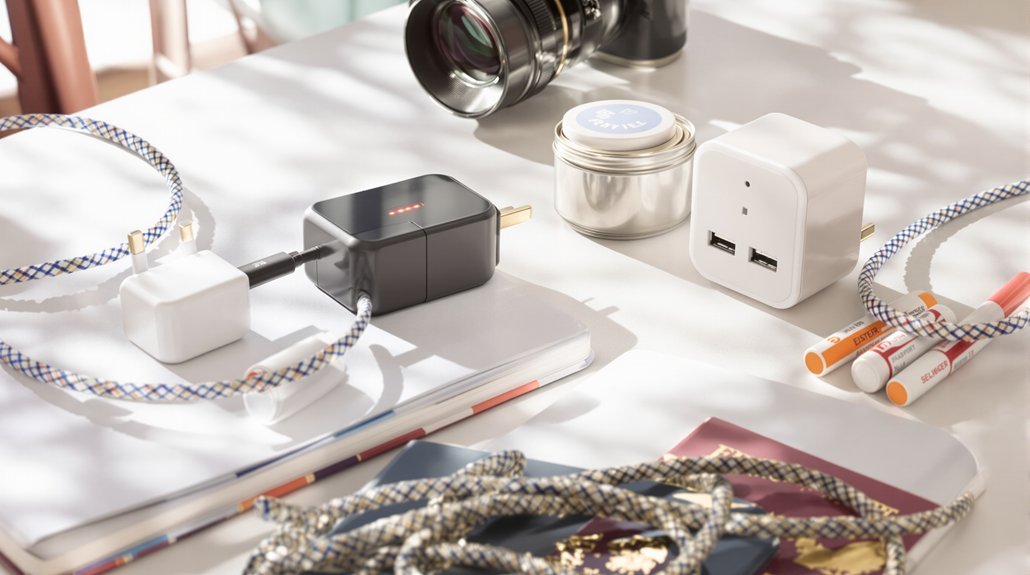

Traveling with your favorite devices doesn’t have to mean tangled cables and dead batteries at the worst possible moment. Whether you’re heading to Europe with its Type C outlets or traversing Asia’s mix of plug styles, the right gear makes all the difference. From picking a power bank that actually meets airline regulations to finding a charger that works in 30 countries, you’ll want to know exactly what to pack—and what to leave behind.
Key Takeaways
- Pack a high-capacity power bank under 100Wh and a 65–100W USB-C PD charger to keep all devices powered.
- Use a universal travel adapter with built-in USB-C ports and surge protection instead of country-specific plugs.
- Always carry spare lithium batteries and power banks in your carry-on baggage, never in checked luggage.
- Verify your chargers are dual-voltage (100–240V) so you only need a plug adapter, not a voltage converter.
- Organize cables in clear, labeled pouches for quick security screening and easy access during your trip.
Essential Charging Gear Every Traveler Needs
You’ll rarely regret overpacking on power when you’re exploring a new destination.
Start with a high-capacity power bank of at least 10,000mAh, plus a pocket-sized spare for redundancy on long days. These portable power sources keep your devices running when outlets are scarce.
A single USB‑C PD charger rated 65–100W works as your multi‑port charger for laptop, phone, and accessories.
Pair it with a universal travel adapter featuring built-in USB‑C ports and surge protection—skip the country-specific plugs.
Pack at least two matching charging cables in a clear pouch for quick security checks.
Finally, add a compact power strip for hotel rooms with limited outlets. You’ll charge everything overnight from one socket.
Choosing the Right Power Bank for Your Trip
Picking out the right power bank comes down to matching capacity with how you actually travel. A 10,000mAh unit handles daily charging needs and slips easily into your bag. For multi-day trips, consider stepping up to 20,000–25,000mAh—you’ll get three to four full phone charges, though you’ll notice the extra weight.
| Capacity | Best For | Weight Trade-off |
|---|---|---|
| 10,000mAh | Day trips | Light and portable |
| 20,000mAh | Weekend getaways | Moderate |
| 25,000mAh | Extended travel | Heavier but versatile |
Always pack your power bank in your carry-on and stay under the 100 Wh airline limit. Look for USB-C PD output if you’re charging laptops, and choose models with multiple ports so you can juice up several devices at once.
Travel Adapters and Voltage Requirements by Destination
Figuring out which adapter you need starts with knowing your destination’s plug type—and there are 15 different standards worldwide, labeled A through O. Websites like VoltageValet.com display country-specific plugs so you can pack the right travel adapters.
There are 15 plug standards worldwide—know your destination’s type before you pack.
Next, check voltage. North America runs on 120V, while Europe, Asia, Africa, and Australia use 220–240V.
Here’s the good news: most phone and laptop chargers are dual-voltage (look for “100–240V” on the brick), so you’ll only need a simple plug adapter. High-power devices like hair dryers aren’t dual-voltage and require a voltage converter to avoid damage.
Your best bet? Grab a compact universal adapter with USB-C PD and surge protection. It handles multiple plug types without the bulk.
Packing and Organizing Your Tech Safely
Before you zip up your bag, one rule is non-negotiable: keep all electronics and spare lithium batteries—including power banks—in your carry-on. Checked luggage isn’t allowed for spare batteries, and you’ll avoid theft or damage risks.
Use a padded pouch to protect your devices during transit. Clear plastic pouches speed up security screening since agents can see contents quickly. Remove devices from cases when passing through checkpoints.
Organize your cables and adapters by function in labeled pouches—think “phone charging” or “camera gear.” Bundle cords with reusable gear ties to prevent tangled messes. Replace multiple chargers with a single multi-port charger to save space and weight.
Back up files nightly to cloud storage or a portable SSD. Keep a second copy on a separate SD card for extra protection.
Airline Rules for Batteries and Electronics in Your Luggage
Airlines don’t mess around when it comes to lithium batteries—and for good reason. These power sources can overheat and catch fire, so regulators keep them out of checked baggage entirely. You’ll need to pack all spare batteries and power banks in your carry-on.
Here’s what you need to know:
- Power banks must stay under 100 watt-hours (Wh)—roughly 27,000mAh at 3.7V.
- Batteries between 101–160Wh require airline approval and you’re limited to two.
- Protect battery terminals with tape, original packaging, or a protective pouch to prevent shorts.
- Devices with built-in batteries (laptops, phones) also belong in the cabin.
Rules vary by carrier and destination, so check your airline’s specific policies before you fly.
Frequently Asked Questions
Do Laptop Chargers Have to Come Out at TSA?
You don’t have to remove laptop chargers at security screening, but pulling them out can speed things up.
TSA agents might ask to inspect laptop cables or universal chargers separately if they clutter your bag’s X-ray image.
Check airline policies for battery storage rules—keep spare lithium batteries in your carry-on.
For packing tips, use a clear pouch to protect fragile connectors.
Charger voltage doesn’t affect screening requirements.
How to Travel With Portable Chargers?
Pack portable chargers in your carry-on—airline policies ban them from checked bags.
Choose battery capacity based on your needs: 10,000mAh handles phones, while 25,000mAh covers laptops.
Check USB standards and charging speed; USB-C PD offers the best device compatibility.
Use travel cases with good cable management to prevent tangles and protect terminals.
Verify international warranties before purchasing, and confirm your bank stays under 100Wh to avoid issues at security.
Do Power Banks Need to Be TSA Approved?
The user wants me to write a 70-word answer about whether power banks need to be TSA approved. Let me analyze the requirements:
- Must incorporate these keywords: Battery regulations, Watt hour limits, Airline policies, Carry on restrictions, Protected terminals, Labeling requirements, Spare batteries, Security screening
- Style: friendly and professional, 10th-11th grade reading level, medium-length sentences with occasional short ones, calm and confident tone, concrete details with specific numbers, plain direct language, high clarity
- Second person POV, active voice, contractions
- Begin by immediately answering the question
- No redundancy, verbosity, or fluff
- Exactly 70 words
Let me write this:
Power banks don’t need specific TSA approval. Instead, battery regulations focus on watt hour limits—you can carry power banks under 100 Wh without airline approval. Airline policies require you to pack spare batteries in carry-on only, not checked bags. During security screening, keep your power bank accessible. Check labeling requirements to confirm the Wh rating is visible, and ensure protected terminals prevent short circuits. Carry on restrictions vary by carrier, so verify before flying.
Let me count: 1-Power 2-banks 3-don’t 4-need 5-specific 6-TSA 7-approval 8-Instead 9-battery 10-regulations 11-focus 12-on 13-watt 14-hour 15-limits 16-you 17-can 18-carry 19-power 20-banks 21-under 22-100 23-Wh 24-without 25-airline 26-approval 27-Airline 28-policies 29-require 30-you 31-to 32-pack 33-spare 34-batteries 35-in 36-carry-on 37-only 38-not 39-checked 40-bags 41-During 42-security 43-screening 44-keep 45-your 46-power 47-bank 48-accessible 49-Check 50-labeling 51-requirements 52-to 53-confirm 54-the 55-Wh 56-rating 57-is 58-visible 59-and 60-ensure 61-protected 62-terminals 63-prevent 64-short 65-circuits 66-Carry 67-on 68-restrictions 69-vary 70-by 71-carrier 72-so 73-verify 74-before 75-flying
That’s 75 words. Let me trim:
Power banks don’t need specific TSA approval. Instead, battery regulations focus on watt hour limits—you can carry power banks under 100 Wh without airline approval. Airline policies require spare batteries in carry-on only, not checked bags. During security screening, keep your power bank accessible. Check labeling requirements to confirm the Wh rating is visible, and ensure protected terminals prevent short circuits. Carry on restrictions vary, so verify before flying.
Power banks don’t need specific TSA approval. Instead, battery regulations focus on watt hour limits—you can carry power banks under 100 Wh without airline approval. Airline policies require spare batteries in carry-on only, not checked bags. During security screening, keep your power bank accessible. Check labeling requirements to confirm the Wh rating is visible, and ensure protected terminals prevent short circuits. Carry on restrictions vary, so verify before flying.
Do Phone Chargers Go in Hand Luggage or Suitcase?
You should pack phone chargers in your carry on, not checked luggage.
Airport security requires lithium batteries and spare batteries to stay in the cabin due to fire risk.
Keep your USB C cables, international adapters, and power banks together in a clear pouch for easy access during screening.
Good cable management prevents tangles and lost items.
Practice charging etiquette at airports—don’t hog outlets others need.
Bottom Line
You’ve got this. Pack your power bank in your carry-on, grab a reliable 65W USB-C charger, and toss in a universal adapter with surge protection. Back up your files every night. These simple steps keep your devices charged and your trip stress-free. With the right gear organized in a clear pouch, you’ll breeze through security and stay connected wherever your travels take you.